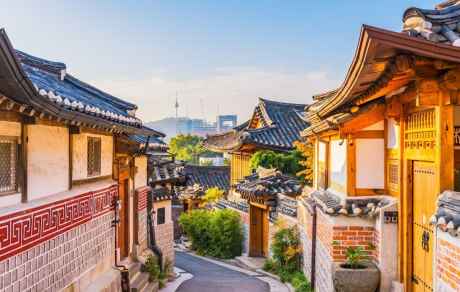
Historic Seoul: Hanok Streets & Royal Palaces
Spend six hours exploring Seoul's historic heart, from Bukchon's traditional hanok streets to the stories behind its royal palaces.
Five days in Seoul is enough time to understand how this city actually works. Not just the palaces and skyline, but the rhythm between neighborhoods, the late-night convenience store runs, and the quiet alleys that pull you off course. I have walked this Seoul itinerary with friends visiting for the first time, and I’ve adjusted it more than once after seeing where energy dipped or crowds built too quickly.
The “I Seoul U” sign at the Han River
This 5-day Seoul itinerary is designed for travelers who want structure without feeling restricted. You will see Gyeongbokgung Palace, explore hanok neighborhoods, experience Korean culture beyond the main tourist attractions, and dive into the kind of Seoul experiences that go beyond a checklist, including street food stalls with fast-moving lines, late-night river walks, and neighborhoods that reveal how the city truly lives. The pacing is realistic. The neighborhoods flow logically. By day 5, you will understand why this city cannot be reduced to one version of itself.
When I map out 5 days in Seoul for first-time visitors, I group neighborhoods by geography rather than popularity. There are endless things to do in Seoul, but without structure, even the best attractions start to blur together. It keeps the pace calmer and reduces unnecessary time on the subway system.
Day 1: Historic Seoul and Hanok Neighborhoods: Gyeongbokgung Palace, Bukchon Hanok Village, Gwangjang Market
Day 2: Modern Seoul and Han River Life: Seoul Forest Park, Han River, Hongdae
Day 3: Museums and Local Neighborhoods: National Museum of Korea or War Memorial of Korea, Seongsu or Yeonnam-dong
Day 4: Views, Markets, and Shopping Districts: N Seoul Tower (Namsan Seoul Tower), Namdaemun Market, Myeongdong
Day 5: Nature or Deeper: Exploration, Bukhansan National Park or a final neighborhood immersion
This 5-day Seoul itinerary flows in a way that feels natural once you are here. Each day builds on the last instead of pulling you back across central Seoul.
Go deeper where this itinerary already takes you, from palace streets and market food to Seoul after dark or keep one day completely open for a private experience shaped around you.
Seoul is large, but it moves in clusters. The key to understanding Seoul neighborhoods is realizing they function like small ecosystems rather than one continuous city. When your days follow geography instead of hype, everything feels smoother.
I have seen visitors try to squeeze three districts into one afternoon. It usually leads to fatigue by Day 3. This structure avoids that. It leaves room for unplanned food stops and small discoveries, which often become the most memorable parts of the trip.
Before booking 5 days in Seoul, these are the questions people usually ask me first.
1) Is Seoul easy to navigate if you do not speak Korean?
Yes. The subway system is clearly labeled in English, stations are numbered, and announcements are multilingual. Google Maps is fine for saving places and checking basic info, but for the most reliable walking and transit directions, use Naver Map or KakaoMap. I have seen first-time visitors arrive nervous about the language barrier and feel confident using public transportation by the second day.
2) How expensive is 5 days in Seoul compared to other major cities?
Seoul is generally more affordable than Tokyo, London, or New York, especially for food and public transportation. Street food, convenience store meals, and casual restaurants keep daily costs reasonable, while hotels range widely depending on location and season.
3) Is Seoul safe for solo travelers?
Yes. Seoul is considered one of the safer major cities in Asia. Violent crime rates are low, public transportation runs late, and neighborhoods like Hongdae, Myeongdong, and Jongno remain active into the evening. Basic city awareness is still important, but most solo travelers feel comfortable quickly.
4) Do I need to plan every day in advance?
No. I recommend choosing one main anchor per day, such as Gyeongbokgung Palace or Seoul Forest Park, and letting the rest unfold naturally. Seoul rewards flexibility. Some of the best food and neighborhood discoveries happen when you leave small gaps in your schedule.
Seoul’s weather can shift quickly, especially in summer and winter. If rain is forecast, swap outdoor stops like the Han River or Bukhansan for the National Museum of Korea or the War Memorial, both of which are easy to explore indoors for several hours. On very humid days above 86°F (30°C), reduce long walking stretches and rely more on subway transfers. If your energy dips midweek, revisit a neighborhood you enjoyed rather than forcing a completely new district.
Keep this first day entirely within central Seoul.
Your first day should be concentrated in central Seoul. This is where traditional Korean architecture, palace courtyards, and preserved hanok neighborhoods give you real context before the city expands outward.
Best for: Traditional architecture, cultural grounding, first-time visitors.
Why go: This area explains how Seoul evolved from a dynastic capital to modern South Korea.
How the day flows:
Keep this first day entirely within central Seoul. There is no need to test multiple subway lines yet. Let the palace grounds, hanok village streets, and market atmosphere introduce you to the city before expanding outward during the rest of your 5 days in Seoul.
Start here: Begin at the main royal palace while the morning is still calm.
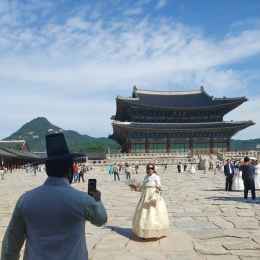
Gyeongbokgung Palace main hall with visitors
Gyeongbokgung Palace is the largest of the five grand palaces and the clearest introduction to Seoul’s royal history. The symmetry of the courtyards, painted beams, and mountain backdrop feels intentional rather than decorative. I never rush this space. I move past the main throne hall into the quieter residential quarters where the scale softens, and the details of traditional Korean architecture become easier to appreciate. Wear comfy shoes. The grounds are expansive and can easily take two hours if you allow them to.
Continue on: Walk uphill into Bukchon without chasing the busiest viewpoints.
Resident sweeping outside hanok home in Bukchon alley
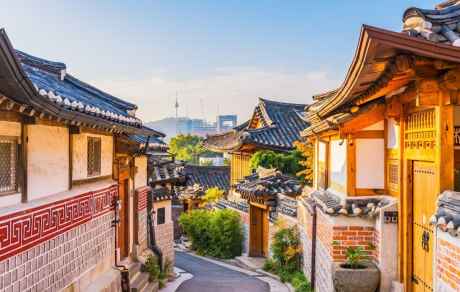
Bukchon Hanok Village sits between major palaces yet still functions as a residential neighborhood. The narrow lanes and preserved traditional Korean houses reveal how families once lived inside the capital. It can be crowded, especially near the main viewpoints, but the side alleys tell a different story. I slow down here and pay attention to rooflines and wooden gates instead of skyline shots. This is not a staged museum. It is a layered history inside modern South Korea.
Alternative: If Bukchon feels overwhelming, Ikseon-dong Hanok Village offers a smaller cluster of restored hanok homes now housing coffee shops and small restaurants.
End here: Let the structure of the day dissolve into food and noise.
Busy food stall at Gwangjang Market with shared bench seating
Gwangjang Market shifts the rhythm completely. Steam rises from noodle soup pots, metal bowls clink against stainless steel counters, and vendors call out orders without looking up. Plastic stools sit inches apart, strangers brushing elbows as trays and counters are wiped quickly between customers. The rhythm is fast and unpolished. You point, you pay, you sit where there is space. I order what looks busy and freshly prepared. A hot bowl of noodle soup. Maybe Korean fried chicken if I want something richer. This is street food culture without ceremony. Point, pay in Korean won, and find space at a shared table. After navigating the Seoul subway system to get here, the city starts to feel less intimidating and more familiar.
Go beyond Gwangjang’s famous stalls and into the markets where everyday Seoul unfolds. Taste local favorites, hear the stories behind them, and discover what you might never know to order on your own.
After the palaces and hanok lanes, this day shifts into how Seoul lives now. Green space, river culture, late-night energy. It is less structured and more observational. Let it breathe.
Best for: Urban green space, local rhythm, contemporary culture.
Why go: This is where you see how residents use the city when they are not sightseeing.
How the day flows:
Start here: Begin in Seoul Forest Park before the late-morning crowds settle in.
People walking and cycling in Seoul Forest Park
Seoul Forest Park feels intentionally spacious. Wide paths, tree-lined walkways, open lawns that are actually used. I like arriving before it gets busy and just walking without a strict plan. Cyclists pass. Parents push strollers. Friends sit with iced coffee from nearby coffee shops. In spring, cherry blossoms draw people in. In summer, the shade matters more than the scenery. What I appreciate most is how it blends into surrounding neighborhoods instead of feeling fenced off. It is green space woven into daily life.
Continue on: Head toward the Han River and watch the tempo shift.
Han River path at sunset with relaxed evening walkers
The Han River is not about dramatic views. It is about how people gather. Mats on the grass. Groups sharing fried chicken. Couples sit quietly facing the water. Around 6 PM, it feels social and picnic-like, but by 10 PM, the energy softens, delivery scooters slow down, and conversations drop to a low hum under the bridge lights. I usually stop at one of the convenience stores near the riverbank, pick up something simple, and sit for a while. It is one of the easiest ways to observe Korean culture without feeling like you are intruding. In the warmer months, the breeze off the water helps. In cooler seasons, people still show up layered in jackets. The river belongs to them.
End here: Let the evening build naturally as the lights come on.
Street musician drawing a small crowd in Hongdae
Hongdae is one of the best places to experience Seoul at night, but it can feel chaotic if you stay on the main strip. I rarely do. Instead, I move a block or two away from Hongdae Walking Street. That is where you find smaller bars, art galleries, and restaurants full of students rather than tour groups. Street art covers side walls and alley corners, changing regularly. Street performances draw tight circles of locals who know the routines. This is where I go for Korean BBQ that feels unpretentious or fried chicken shared at a plastic table. It is loud, creative, and unapologetic. After 11 PM the main strip can feel overwhelming, with performers competing for volume and crowds barely moving, which is why stepping one street back makes such a difference. If you want to understand younger Seoul, this is where you stand and watch.
Independent shops, street art, creative spaces, and student hangouts give Hongdae a personality unlike anywhere else on this itinerary. Explore beyond the busiest streets with someone who knows what is worth stepping into.
Explore HongdaeBy now, the city should feel less overwhelming. Day 3 adds context. This is where you begin to understand the forces that shaped modern South Korea and why Seoul looks and functions the way it does.
Best for: Historical context, deeper understanding, slower exploration.
Why go: Without this layer, palaces and neighborhoods remain surface-level experiences.
How the day flows:
Option 1: Arrive early and focus on specific eras rather than trying to see everything.
National Museum of Korea with pavilion and reflecting pond
The National Museum is large enough to consume an entire day, which is exactly why I never try to conquer it. I move chronologically and stop when something holds my attention. Ceramics. Buddhist sculpture. Royal artifacts. The transitions between dynasties explain the architectural language you saw on Day 1. You begin to see how traditional Korean architecture evolved instead of appearing fully formed. Two hours is usually enough for a focused visit. Any longer and it turns into information overload. Entry to the permanent galleries is free, which makes this one of the most valuable cultural stops in Seoul.
Option 2: Choose this instead if modern Korean history interests you more.
War Memorial of Korea statue viewed from behind a quiet visitor
The War Memorial adds weight to everything you have experienced so far. The Korean War is not abstract history here. It reshaped families, borders, and the rapid rise of South Korea as one of Asia’s major cities and economic powers. I spend more time in the indoor galleries than outside with the aircraft and tanks. Personal stories matter more than machinery. It is not a light visit, but it is necessary if you want to understand the tension between North and South Korea that still defines parts of public life today. Plan for about 90 minutes. It’s detailed and emotionally heavy.
End here: Choose a neighborhood and explore without a checklist.
This is where I stop planning. Yeonnam-dong near Hongik University feels relaxed, with independent coffee shops and small restaurants filled with locals rather than tour groups. Seongsu, a bit south of central Seoul, leans industrial and creative, with converted warehouses housing art galleries and design-driven cafés. I walk until something pulls me in. A bakery window. A mural. A side street that feels lived in. This is when Seoul stops feeling like a Seoul itinerary and starts feeling personal. It is also where many of my favorite hidden gems in Seoul quietly reveal themselves, usually in the form of a café, gallery, or side street that was never on a checklist to begin with.
Food note: Skip the obvious chains and try somewhere with a short wait and steady turnover. That is usually your best indicator.
By now, you know what has caught your attention. Spend four private hours going deeper into the neighborhoods, food, culture, or everyday Seoul you want more of, with a host who shapes the route around you.
By Day 4, you understand the ground level. Now it helps to see the city from above and then drop back down into its commercial core. This day balances panoramic perspective with the reality of how people shop, eat, and move through central Seoul.
Best for: Big-picture views, market culture, modern retail districts.
Why go: Seeing the skyline and street-level commerce together helps connect historic Seoul with the global city it is now.
How the day flows:
Start here: Go earlier in the day for lighter crowds, and check visibility before you set out.
Stone path through Namsan Park leading toward Seoul Tower
N Seoul Tower sits above the city rather than inside it, which is exactly why it matters. From the observation deck, the density of Seoul becomes obvious. Mountains framing apartment blocks. The Han River cuts horizontally through districts you have already walked. I usually take the Namsan cable car up rather than hiking. It keeps the morning efficient and gives you a visual transition from the city grid to the forested slope. From the top, you can trace your previous days and spot areas you have not explored yet. It turns abstract geography into something readable. Visibility can vary, so a clear day matters more than the exact time you visit.
Continue on: Move back down into the city and into the noise.
Busy Namdaemun Market street filled with local shoppers and stalls
Namdaemun Market feels less curated than other main tourist attractions. It is chaotic in places, and that is part of its appeal. Clothing, kitchen tools, textiles, and snacks. Vendors call out prices, and regular customers move quickly with purpose. I come here less for souvenirs and more to observe how daily commerce works. The food stalls here are direct and practical. A fast bowl of noodle soup. Fresh dumplings. Something sweet eaten standing. It is not polished, and it does not try to be.
Food tip: Eat where there’s a short, fast-moving line rather than where menus are heavily optimized for tourists.
End here: Let the evening shift into neon and movement.
Busy Myeongdong shopping street
Myeongdong is commercial, yes. But dismissing it misses what it represents. This is where global fashion, K-beauty, and mass retail intersect in one compact district. I step into Olive Young not because I need skincare advice, but because it shows how detailed and product-driven Korean beauty culture has become. Rows of sheet masks, sunscreen, cleansers. It reflects modern South Korea’s influence beyond its borders. Even if you buy nothing, walking through the streets after dark, with street food stalls lining the edges, adds a different kind of energy to the trip. Evening crowds build quickly, especially on weekends. Keep your movements simple and avoid the peak dinner rush if possible.
The final day should not feel rushed. By now, you know which parts of Seoul pulled you in. This day either takes you into nature or gives you space to go deeper into one district that still feels unfinished.
Best for: Flexibility, fresh air, or personal closure.
Why go: The last day should reflect your energy level, not a checklist.
How the day flows:
Start here: Begin early if you choose the hike.
Granite ridge hike in Bukhansan overlooking central Seoul
Bukhansan National Park surprises people. You leave the subway system, and within minutes you are climbing granite slopes with sweeping views back toward the skyline. This is not a casual stroll. Trails are steep in sections, and locals treat hiking seriously. I do not push for a summit unless conditions are clear and energy is high. Even a partial ascent gives you a perspective over central Seoul and the surrounding mountain ridges. It explains how nature still shapes the city’s boundaries.
Practical note: Check weather conditions before going. Trails can be slippery after rain, and winter temperatures often drop below 32°F (0°C).
Continue on: Choose a district that felt unfinished earlier in the week.
Gangnam suits travelers curious about modern corporate Seoul. During the day, cafés fill with remote workers and business meetings, and the wide boulevards feel deliberate and polished. After dark, the tone shifts toward upscale dining and nightlife rather than street chaos.
Itaewon works well if you want international restaurants and a visibly mixed crowd. English is heard more frequently here, and weekday afternoons feel calmer than weekends, when the bar scene becomes louder and more concentrated.
Dongdaemun is best saved for late evening. Fashion buyers move quickly between wholesale markets, and some shopping complexes stay open past midnight. It feels transactional and energetic rather than scenic, especially after 9 PM.
I usually pick one and walk without forcing landmarks. A final coffee. One last meal. A slow circle back to a favorite street. This is where the trip becomes personal instead of structured.
End here: Return to something that felt right earlier in the week.
Korean BBQ dinner shared around a tabletop grill in Seoul
Maybe it is Korean BBQ done properly. Maybe a quiet bowl of noodle soup. Maybe fried chicken shared with someone you met along the way. I avoid trying to cram in one more main tourist attraction. The last evening should feel settled. When I leave Seoul, it is rarely the monuments I remember first. It is the smaller rhythms. The subway doors are closing. The sound of market vendors. The way the city shifts after dark.
Seoul eats according to rhythm, not trend. Some meals are loud and shared, others are quick and practical. If you are wondering what to eat in Seoul, the answer depends on time of day, neighborhood, and mood. Once you understand where to go and how to order, eating here becomes one of the easiest parts of your 5 days in Seoul.
What to expect: Noise, short queues, shared stools, and food made in front of you without ceremony. Markets are about momentum, not perfection.
What to order: At Gwangjang Market, start with bindaetteok and mayak gimbap. At Namdaemun, go for kalguksu or hotteok for a quick sweet treat. Myeongdong street food works for snacks, but I treat it as a quick stop, not a full meal.
Crowded food stalls inside Gwangjang Market in Seoul
I love markets because they show you how Seoul eats when nobody is performing for tourists. You stand, you order by pointing, you eat quickly, and you move. The lighting is harsh, the pans are seasoned from years of use, and the turnover keeps everything fresh. If I want to understand a neighborhood, I go to its market first.
What to expect: A full table, built-in grills, side dishes arriving automatically, and a meal that takes time. You cook together, you wrap the meat, you talk between bites.
What to order: Samgyeopsal is the safest starting point. Add one additional cut if you are with a group. Wrap the meat in lettuce with garlic and ssamjang instead of eating it plain.
Barbecue in Seoul is not just about the meat. It is about the pace. I recommend it on your second or third night, once you are settled and not exhausted. The smoke, the noise, the way people linger over soju, it all feels intentional. If you leave smelling like charcoal, that means you chose the right place.
What to expect: Simple dining rooms, quick service, bubbling stone pots, and meals built around rice and soup rather than spectacle.
What to order: Kimchi jjigae, sundubu, or a simple noodle soup are reliable on cooler days. When temperatures climb above 80°F (27°C), cold noodles like naengmyeon make more sense. Convenience stores also become part of the daily rhythm, especially near the Han River at night.
Clay pot of Kimchi Jjigae bubbling with pork belly and tofu
This is the food I recommend when you are tired from walking in central Seoul. One hot stew, rice, and side dishes, and you are done. No planning, no reservations, no pressure. Even grabbing triangle kimbap and eating by the river feels normal here. Seoul does not require every meal to be an event.
These habits are subtle, but following them makes you feel less like a visitor and more like someone who understands the rhythm of the room.
Five days in Seoul are full. I only suggest day trips from Seoul if you are looking for something specific that the city itself does not give you. If you do go, choose one. Do not stack them.
Best for: Travelers who want to understand North and South Korea beyond headlines.
A DMZ tour adds political and historical weight to your trip. It is structured, security-controlled, and requires advance booking through licensed operators. Most tours last 8 to 10 hours, including transport from central Seoul.
Visitors view North Korea from a DMZ observation deck
This is not a casual outing. It is quiet, reflective, and sometimes emotionally heavy. I suggest it only if modern Korean history genuinely interests you. Otherwise, your time may be better spent exploring another Seoul neighborhood more deeply.
Best for: A lighter day with space to breathe.
Incheon is easy to reach by subway and feels immediately different from central Seoul. Start in Incheon Chinatown near Incheon Station, wander the narrow streets, then walk toward the waterfront near Wolmido Island for open harbor views.
This works well on warmer days above 75°F (24°C) when sea air feels welcome. It is not a dramatic sightseeing. It is a reset day. Sometimes that is exactly what a 5-day Seoul itinerary needs.
For most first-time visitors, though, I recommend staying in Seoul. The city has more depth than it reveals in a quick glance, and five days disappear faster than you expect.
Best for: Architecture and open space without a full-day commitment.
About one hour from central Seoul on Line 1, Suwon Hwaseong Fortress is a UNESCO World Heritage Site built during the late Joseon Dynasty. The fortress walls stretch roughly 3.5 miles (5.7 km), and walking sections of them feels different from palace courtyards in Seoul. It is slower. Less crowded. More spacious.
Suwon Hwaseong pavilion with visitors on the stone platform
I usually recommend this if you feel palace fatigue but still want historical context. You can walk the walls, explore gates, and return to Seoul by evening without feeling rushed.
A local can, in a 1-on-1 call tailored to your trip.
Even a well-planned 5-day Seoul itinerary can feel rushed if you stack the wrong things together. These are the mistakes I see most often when visitors try to do too much too quickly.
Five days in Seoul works best when you leave room to pause. Some of my favorite moments here happened because I adjusted the plan slightly instead of pushing through it.
GJ is full of energy and enthusiasm, she is interesting and a fun tour guide! We had a top level experience!Anastasia, Seoul, 2026
Seoul feels completely different depending on the season. I always tell visitors to choose their travel dates based on the experience they want rather than just flight prices.
Spring (April–May)
What to expect: Cherry blossoms, mild temperatures, and noticeable crowds in central Seoul. Parks and palace grounds are especially busy on weekends.
What to wear: Light layers, comfortable walking shoes, and a light jacket for cooler evenings.
Summer (June–August)
What to expect: Hot and humid weather is often above 86°F (30°C). July usually brings heavier rainfall during the monsoon season.
What to wear: Breathable clothing, good walking shoes, sunscreen, and a compact umbrella.
Fall (September–October)
What to expect: Lower humidity, clearer skies, and autumn colors in mountain areas around the city.
What to wear: Light layers during the day and a medium jacket after sunset.
Winter (December–February)
What to expect: Cold temperatures frequently below 32°F (0°C), fewer tourists, and crisp visibility on clear days.
What to wear: Insulated coat, gloves, scarf, and proper winter footwear with grip.
Seoul works year-round. The key is adjusting your daily pace to the season rather than trying to follow the same schedule in July that you would in October.
Once you understand transportation and payments, Seoul becomes much easier to navigate. These small details shape how smooth your trip feels.
ITX ticket machines at Yongsan Station
I always carry a small amount of cash, even though I rarely need it.
Five days in Seoul will not show you everything, but it will show you enough to understand why this city lingers. You will remember the stillness inside Gyeongbokgung Palace, the steep lanes of Bukchon Hanok Village, the late-night hum of convenience stores near the Han River, and the way each neighborhood feels slightly different from the last. Somewhere between a bowl of noodle soup and a quiet subway ride home, the city stops feeling overwhelming and starts feeling familiar.
Locals walking along a lively Seoul neighborhood street
It rarely happens inside a landmark. It happens on a quiet subway ride back to your hotel, the recorded chime announcing the next stop while someone beside you scrolls through their phone. It happens over a late bowl of stew when the steam fogs the window. Those smaller moments, more than the headline attractions, are what define the South Korean experiences that stay with you long after you leave. That is the version of Seoul that lingers.
A local host helps connect each day, so you spend less time backtracking and more time experiencing the palaces, markets, neighborhoods, and local life you came for.
Talk one-on-one about what to see, what to skip, and which neighborhoods fit naturally together. Leave with a 5-day Seoul plan shaped around you.
Get matched with someone who knows when to slow down, where to skip the obvious route, and which corners of Seoul are worth making time for.